
Digital platforms give business schools global reach
Disruption is the objective of numerous technological know-how start out-ups. But, in the education sector, a number of tech ventures are creating businesses based on encouraging — alternatively than competing with — colleges and universities.
These on line education platforms — these as Coursera, 2U, Udacity and FutureLearn — initially started off out with utopian visions of cost-free mastering as a result of chunk-sized tutorials, recognized as large open on line classes (Moocs). Some Moocs proved massively common, but superior dropout costs and the challenges of monetising this mastering convinced the platforms to kind partnerships with universities in its place, to operate compensated-for classes with them on line, and share the income.
As a organization product, it had been getting traction in advance of the coronavirus pandemic hit. Even so, the lockdown of campuses and people’s motivation to retrain through a time of turbulence in the positions sector has driven up purposes substantially in the earlier 12 months.
Between the sights of these on line education platforms is their ability to serve pupils close to the globe, which has inspired some organization colleges to go all out with a digital method.
Gies School of Enterprise, portion of the College of Illinois at Urbana-Champaign, partnered with the Silicon Valley-based Coursera in 2016 to supply an entirely on line MBA programme — winding down its campus-based MBA study course in the course of action. Its iMBA now has pretty much four,000 pupils, up from an ingestion of 114 in its first 12 months. Each pays just under $22,000 in tuition costs — significantly significantly less than the six-determine sums required for the highest-rated campus-based MBA programmes but a lot more than other on line MBAs.
![Brooke Elliott, associate dean at Gies College: ‘[Coursera] want to scale and so do we’](https://www.ft.com/__origami/service/image/v2/images/raw/https%3A%2F%2Fd1e00ek4ebabms.cloudfront.net%2Fproduction%2Feb12dfd9-977c-49a4-b1e4-15978d79e45c.jpg?fit=scale-down&source=next&width=200)
Coursera is enabling the university to achieve nations and candidates it could hardly ever have acquired to as a result of its own promoting initiatives, in accordance to Brooke Elliott, associate dean at Gies.
“Our goals were being aligned with Coursera due to the fact they want to scale and so do we — in our situation, to realize our mission as a public university of supplying the broadest accessibility to education,” she says. A even further gain, Elliott provides, is that Coursera’s worldwide community of learners and organization associates supplies insights into what Gies ought to be educating.
While alliances with on line platforms have enabled colleges to help save money on establishing in-property digital educating instruments, Elliott says Gies has had to make a substantial expenditure in on line mastering alone. This has been needed to make the content — by creating 4 output studios and using a 39-particular person “e-learning” workforce to create study course substance — and to retain all the intellectual house in the educating.
World-wide viewers
Rival platform FutureLearn has also been capitalising on the change to on line mastering. Founded in 2012 by the UK’s Open College, it now has partnerships with a lot more than a quarter of the world’s top higher education institutes and organization colleges.
When it signed the first of these, in 2015, administration and organization classes were being the third most common study course classification on the platform. Now, they are number one particular.
“We assistance our associates achieve audiences and markets that maybe they are unable to on their own,” says Justin Cooke, FutureLearn’s chief content and partnerships officer, noting that the platform’s organization and administration classes attract a lot more ladies than adult males, in contrast to most major MBA classes.
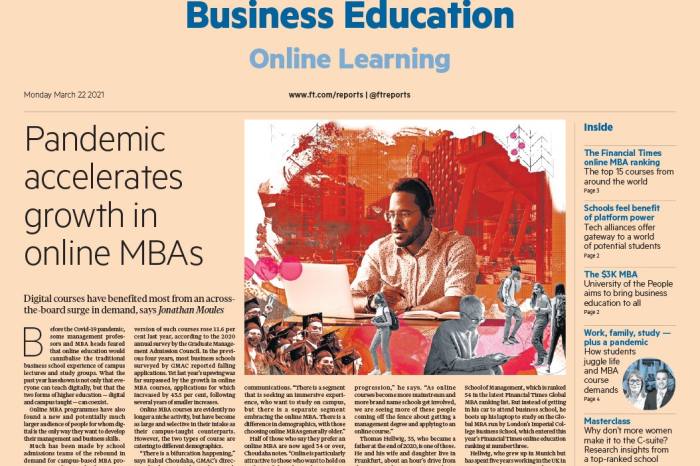
See the whole 2021 Fiscal Periods On-line MBA directory as effectively as the whole report on Monday March 22
“We are a market with 15m learners from every place in the world,” Cooke says. “Even a world-class organization university is not reaching that dimensions of viewers.”
But although organization colleges have been swift to embrace platform tie-ups, they are also mindful that their campus-based educating models have lots of life in them yet.
HEC Paris started off educating a entirely on line MSc in innovation and entrepreneurship making use of Coursera in 2017. Its associate dean of government education, Anne-Valérie Corboz, says: “The essential issue for us is to build partnerships outside our campus partitions.” Nevertheless, although she praises the “flexibility and adaptability” of the on line product, she provides: “Online education is not recession evidence and it will not swap our educating offline.”
Traders wanted
Without a doubt, for all the progress in on line mastering, the platform product has still to establish alone. Unique platforms go on to compete with each other to sign up instructional establishments, and arise as a “winning brand” in a sector that seems ripe for consolidation.
Some feel expenditure will be vital. This thirty day period, Coursera introduced a program to elevate up to $100m as a result of an initial public offering on the New York Inventory Exchange. Founded in 2012 by two Stanford computer system science professors, it now boasts a lot more than 77m registered learners and two hundred associates throughout higher education and market.
But not all of its customers select to go after — and pay for — diploma certification soon after consuming cost-free study course content, which leaves Coursera with a mixed tale to tell buyers. In 2020, income rose 59 per cent to $293.5m 12 months-on-12 months, but losses also grew by 43 per cent more than the similar time period to about $sixty six.8m — and the firm reported it would go on to post losses for the foreseeable future. FutureLearn is also lossmaking and has not established a date for turning rewarding, Cooke says.
None of this is uncommon for an on line progress organization. It is, even so, a sign of how substantially money might be needed to make on line education — as a organization product — perform out.