
Investors search for Asia safe havens as virus prompts diverging policies
The threat of the omicron variant is starting to be true for many of Asia’s largest nations just as it seems set to subside in some Western nations, and that’s complicating investors’ search for successful share bets in the area.
The trouble is that Asian governments are carrying out greatly diverging coronavirus insurance policies, with procedures ranging from China’s pursuit of Covid Zero to Australia’s go to stay with the virus, and pretty much every little thing in among. The speed of vaccinations and the power of health-care methods also vary greatly in the area.
It is a different example of how Covid is forcing buyers to encounter new problems, nevertheless many stay constructive about Asia’s means to climate the storm as its ideal-accomplishing nations retained fatalities from the pandemic at amounts considerably lower than somewhere else. Asian stocks have carried out better than their European and U.S. counterparts so considerably this year, immediately after underperforming both of them in 2021.
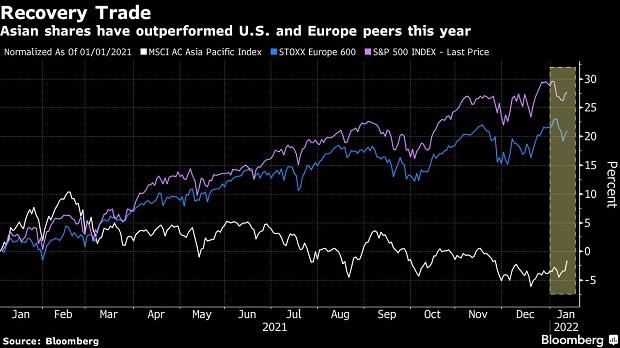 “Asia will be better braced to cope with omicron waves, which may show to be much more brief-lived,” claimed Wai Ho Leong, a strategist at Modular Asset Administration. “Markets that are better vaccinated and have timely social distancing curbs are also likely to get well faster from this wave.”
That, he says, details to Singapore, South Korea, Taiwan, China and Malaysia as likely winners, with India, Thailand and the Philippines just setting up to see surges. Customer discretionary, autos and banking companies are among the sectors to guess on, he claimed.
Western nations from Switzerland to Spain and the U.K. have suggested that the coronavirus pandemic may be shifting to an endemic period. In Asia, the omicron variant wave is setting up to pounce, with circumstances surging in Australia, a bounce in Tokyo infections prompting authorities to increase the Covid notify, and Hong Kong extending social limitations.
‘Rich-State Narrative’
Exhausted by lockdowns, European nations have mainly eschewed a return to onerous curbs. Quite a few nations in Asia are “refusing to acquire into the wealthy-state Western narrative that it is milder and will have a lower web impact,” wrote Jeffrey Halley, senior market analyst for Asia Pacific at Oanda, in a Jan. ten report.
The region’s two biggest marketplaces are among them. For some, China’s proven good results in stamping out the virus when discovered usually means buyers there have very little to be concerned about from omicron.
“While isolated lockdowns could disrupt a particular location quickly, it is likely to have very little impact on the financial state as a whole,” claimed Jian Shi Cortesi, investment director for China and Asia growth equities at GAM Investments in Zurich. “China’s financial state has adapted to zero-Covid measures, with most sectors operating typically. For most individuals it is lifestyle as common.”
But other people are asking yourself how very long that strategy can be maintained. Morgan Stanley reduce estimates for Hong Kong’s financial state as the city again turns to rigid curbs, likely delaying a re-opening with the mainland. China’s lockdowns stay regional but could become much more widespread.
“The odds of a China growth shock for the reason that of omicron and Covid Zero are steadily rising by the day,” Oanda’s Halley wrote.
Japan was among the initially nations to try a “living with the virus” strategy in 2020, but below the administration of Key Minister Fumio Kishida Covid coverage has grown much more careful inspite of 80% of the state acquiring had two vaccine photographs.
“Japan is now the most rigid state in the cost-free world” in terms of border control, claimed Richard Kaye, a portfolio manager at Comgest Asset Administration Japan Ltd., which oversees about $ten billion in Japanese equities. Conversely, he says the strictness makes it the suitable reopening play.
“We can spend in the reopening tale with a much more substantial, increased visibility than we have in other major economies,” he claimed. Kaye sees airlines, airport operators, railroads and retail likely to reward when at some point the rigid borders are opened.
So considerably this year, Japan’s blue-chip index Nikkei 225 has underperformed the Asia benchmark by about 3 proportion details.