
Most MBA alumni go into a narrow range of careers
Greater variety in the workforce might make excellent organization as very well as ethical sense — but it continues to be minimal in the lecture rooms of main organization educational facilities.
A Monetary Periods investigation of a lot more than a hundred,000 respondents from top rated organization educational facilities shows that, about the previous 10 years, most MBAs came from and returned right after graduation to a slender range of careers, with practically 50 % having employment in finance, consulting and know-how.
Although some educational facilities search for to attract and educate pupils for a broader range of employment, from a sample of a lot more than seven,000 alumni who graduated in 2018 less than six for every cent came from federal government, charities and social enterprises. And, this yr, just two.seven for every cent have been working in those people sectors.
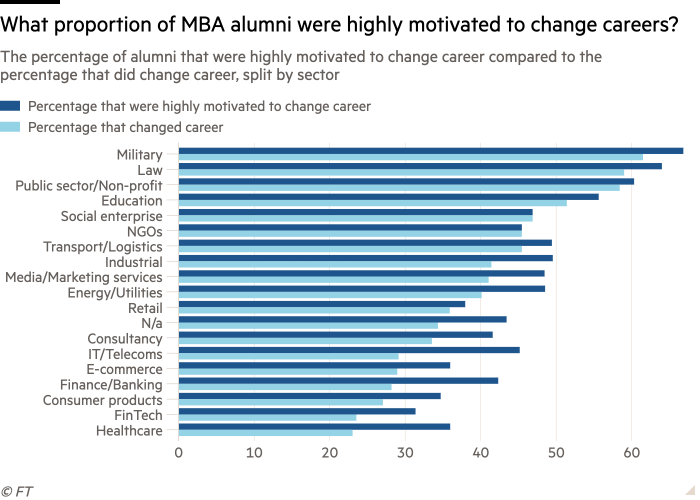
Persons recruited from these non-company companies — as very well as those people from instruction, the navy and law — have been also among those people who claimed they most desired to alter careers by having an MBA.
Making use of the Herfindahl index, a evaluate of the measurement of corporations in relation to their industries, the multi-campus Hult International Small business Faculty had the most assorted pupils by employment sector prior to setting up an MBA in 2018, followed by the Marshall Faculty University of Southern California and the Smith Faculty of Small business in Canada.
The Chinese University of Hong Kong Small business Faculty had the most assorted employment results 3 a long time right after graduating, followed by the Ross Faculty at the University of Michigan and the Rotterdam Faculty of Administration.
The FT also collects data on gender equilibrium among pupils, college and governance bodies of organization educational facilities, and observed it has improved in latest a long time — as very well as the breadth of nationalities represented at the establishments.
A fuller range of variety indicators would involve the social, economic, ethnic and spiritual backgrounds of applicants, as very well as those people with actual physical disabilities, neurodiversity and sexual orientation. Having said that, variants in between international locations in less than-represented groups and regulatory limitations on data collection make such steps complicated to accumulate and compare.