
Virtual classrooms democratise executive education
As universities closed their school rooms and organizations adjusted to the disruption of the coronavirus pandemic final yr, PepsiCo’s chief discovering officer, Molly Nagler, had to scrap programs to deliver executives to programmes at Wharton College and Yale College of Administration.
But fairly than dismiss govt education as impractical, unaffordable or unjustifiable during a crisis, Nagler doubled down and negotiated online choices for the US-dependent food items and drinks group.
“We have a tendency to use the in-human being, campus-dependent programme for executives to produce a differentiated practical experience and expose them to cutting-edge considering and investigate,” she says. “We’ll nonetheless use the campus for elite activities but much less than prior to mainly because of the expense and the obstacle to get all people in 1 spot.”
Like a lot of of her counterparts in organizations about the earth, Nagler is not cutting back again on her training budget. Rather, she is reconsidering who should really discover, what they should really analyze and how best to prepare them — and examining her choice of exterior programmes.
Coronavirus imposed a sharp shock on organization schools’ non-degree “open” courses for supervisors and bespoke “custom” offerings for company customers. When need for qualifications these types of as the MBA has held up nicely, the world wide university-dependent govt education market, well worth shut to $2bn in 2019, fell by a third in 2020.
François Ortalo-Magné, dean of London Company College, says its govt programmes produced £50m a yr prior to Covid-19, but that total has because halved. “The pandemic has not been straightforward,” he says.
Michael Malefakis, head of govt programmes at Wharton, agrees it has been a really difficult time: “We’ve pushed ourselves and the market has pushed us significantly from our previous ease and comfort zone. It is built us rethink how we construction and provide education in a way that has not been as radical because earth war two.”
The great information for education providers is that hunger remains strong. Mark Roberts, associate dean of govt education at Insead, draws a contrast with the 2008 financial crisis, when training programmes were found as “something you switch off as an expense in a knee-jerk way”. He provides: “We haven’t found that this time. One thing fundamental has shifted strategically.”
Furthermore, Nuno Gonçalves, chief discovering and development officer at Mars, has not found his budget drop. “Every strategic paper I see talks about ‘people capabilities’, about what we require tomorrow,” he says. “If we want to be profitable, we require to have these capabilities.” Along with “hard skills” centered on digital transformation and analytics, Gonçalves sees need for the “soft skills” that foster leadership features these types of as empathy — and how to harmony them with the continuing require for commercial achievement.
Josh Bersin, a US company discovering guide, agrees that coronavirus has centered organizations on “people issues” and absent from management philosophies. “It’s about human-centred leadership which is much more caring,” he says. Tied to this is range and inclusion, subjects that are “on employees’ minds, reporters’ minds, all those of rankings, with shoppers selecting not to invest in products and solutions from organizations that are not getting fair. We have identified range has scarcely been addressed, and if everything we have been backsliding.”
Along with the acquisition of unique expertise, training programmes give a crack from the relentless pressures of day-to-day operate in lockdown. “Companies are on the lookout for significant engagements for workers that are not just about operate or a Zoom bash,” says Ortalo-Magné of London Company College. “We have offered time for participants to chat with our school to convey them that means as nicely as discovering.”
What do you consider?
The FT would like to hear from chief discovering officers about their sights on topics, budgets and methods of discovering. Make sure you total our small survey at ft.com/closurvey by March 5. The outcomes will sort section of our Govt Schooling report in May possibly.
Matt Confer, a vice-president at Abilitie, a business which delivers training these types of as organization simulations, says a lot of customers are interested in training mainly because it allows with staff retention and enthusiasm. “People have been at residence much more than any of us required or anticipated and we’re receiving burnt out,” he says.
Proven in 2015, Abilitie — which now delivers a mini online MBA — claimed its best two financial quarters in the 2nd fifty percent of final yr.
When encounter-to-encounter meetings can produce a abundant discovering practical experience not normally replicable online, digital seminars, courses and functions make it easier to bring in both higher-profile exterior speakers, these types of as chaotic chief executives, and customers who battle to take time off for total-time analyze. Technological innovation has also established much less daunting suggests for participants who are shy to discuss out.
Digitisation raises a broader challenge for company discovering officers about the “democratisation” of training. When costly on-campus programmes were generally minimal to a smaller group of senior executives, online discovering can offer you a wider assortment of training much more cheaply and competently to a significantly larger sized range of staff at unique levels in an organisation.
FT survey: Are you a working parent? How has the pandemic impacted you?
The pandemic has turned everyone’s life upside down, but it has been specifically disruptive for a lot of moms and dads as they juggle operate, housework and homeschooling. We want to know how it has been for you.
Make sure you fill out this sort. Your participation will be integral to our reporting.
Erin Clark, exercise chief for leadership development and discovering at experienced companies organization Deloitte, says: “It’s about leadership at all levels — some thing that can no longer be reserved for the decide on several. Expenditure in building leaders was disproportionately anchored in hierarchy. Digital discovering delivers the prospect to be commonly available.”
The need for online training is intensifying the levels of competition in between organization educational facilities and alternate providers of govt education — organizations which may possibly have much less tutorial heritage but which can be much more nimble. Deloitte, like other consultancies, recruiters and expert firms, as nicely as online educators from Abilitie to Coursera, are expanding.
Andrew Crisp, co-founder of the education consultancy CarringtonCrisp, says the pandemic “is the finish of luxurious discovering, with the board at a 5-star hotel for a weekend”. Company educational facilities, he thinks, “are heading to have to sharpen up mainly because the new entrants are much more fleet of foot in responding to customers”.
But Ravi Kumar, president of Infosys, sees a continuing require for engagement with universities, as they refocus on everyday living-long discovering. “They will have to pivot,” he says. “Executive education was about refreshing what you had learnt. Now discovering is about switching from 1 job or occupation to an additional. Schooling and operate will be intertwined.”
The deserves of the digital classroom
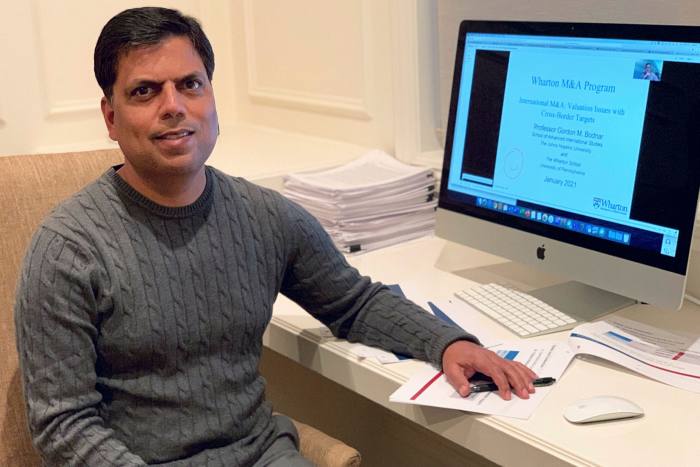
Just when Sumit Tomar was due to start off an superior finance course at Wharton College in March final yr, the pandemic pushed his govt training entirely online.
But the electrical engineer, who life in San Diego, has no regrets. “The digital classroom serves my requires completely,” he says. “With the time big difference, I can analyze from 6.30am till 11am and then have sufficient time to do my day occupation until eventually 8pm. If I have some urgent operate, I can stroll out and arrive back again to check out the lectures once again in the evening.”
Quite a few organization educational facilities have suffered setbacks to their superior management programmes, with applicants discouraged by the compelled change to digital discovering. But Tomar was happy to pay out the total $sixty seven,000 cost and keep away from the inconvenience and prices of journey. “It’s not cheap but it was unquestionably well worth the funds.”
Tomar is chief govt of pSemi, a semiconductor business. He says Wharton’s course, moreover a former 1 in basic management at Stanford a decade in the past, were a substitute for an MBA.
“I could by no means picture finding out total time: that is two many years, a whole lot of funds used and you are out of operate. When I’m working, I’m discovering in parallel and making use of classes in the authentic earth.”
He admits that “the bonds you build in human being are not the exact factor as a digital dangle-out”, but that the digital structure has built it attainable to bring in higher-high-quality participants from about the earth, as nicely as foremost organization figures ready to discuss to his courses online.
He predicts the online structure will help reinforce the posture of foremost educational facilities. “Even if the pandemic is above, the digital classroom won’t go absent,” he says.